The 1:5 Ratio: Navigating the Diamond Workforce
In a recent PwC survey, 48% of executives said they expect to increase their headcount because of AI agents. On the surface, that sounds like a failure of technology—wasn’t AI supposed to automate us out of a job?
But I think we’re seeing a ‘Headcount Paradox.’ The work isn’t going away; it’s being reallocated. We are witnessing the death of the traditional middle manager and the birth of the Builder-Orchestrator.
The 1:5 Law#
In the legacy corporate world, scaling was a simple math problem: more work required more human hands, which required more middle managers to coordinate them. In the agentic world, we scale with specialized digital labor.
But there is a cognitive ceiling to this leverage. Based on my experience building agentic systems—orchestrating everything from deep-dives into country-specific regulatory risks to assessing and modeling risk using the FAIR method—a recurring pattern has emerged: the 1:5 Ratio.
A single human can effectively direct and audit the work of roughly five specialized agents. To be clear, this doesn’t mean you can’t have twenty agents executing sub-tasks in the background. But 1:5 is the sweet spot for the direct human-to-agent reporting structure. Those five primary agents might manage dozens of sub-agents, but the human cognitive load caps at maintaining state across five top-level contexts. Beyond that, the mental load starts to fray. You lose the ability to catch the subtle hallucinations or the logic drifts that happen at the edges. A 1:5 pod allows a single professional to operate with the reach of an entire legacy department, but only if they stay at the center of the orchestration.
The Human Signature#
I’ve noticed it’s becoming painfully obvious when a professional does a ’lift and shift’ directly from an AI. The output is technically correct but hollow. It lacks the skin in the game.
I think we’re entering an era where the primary value of a human isn’t their ability to produce the work—it’s their ability to ‘signature’ it.
When I run a risk assessment through my agent stack, the AI does the heavy lifting of data ingestion and synthesizing. But I don’t just ship the result. I read it, I revise it, and I pressure-test the conclusions. I’ve found even frontier models today can miss important nuances or even oversimplify. I’m not hiding that the AI did the legwork, but the final outcome carries my signature. I claim the work because I stand behind the judgment. In a world of infinite AI noise, the human guarantor is the only thing that still commands a premium.
The Diamond Workforce#
The legacy corporate pyramid—wide at the bottom with entry-level execution and narrow at the top—is being crushed into a diamond.
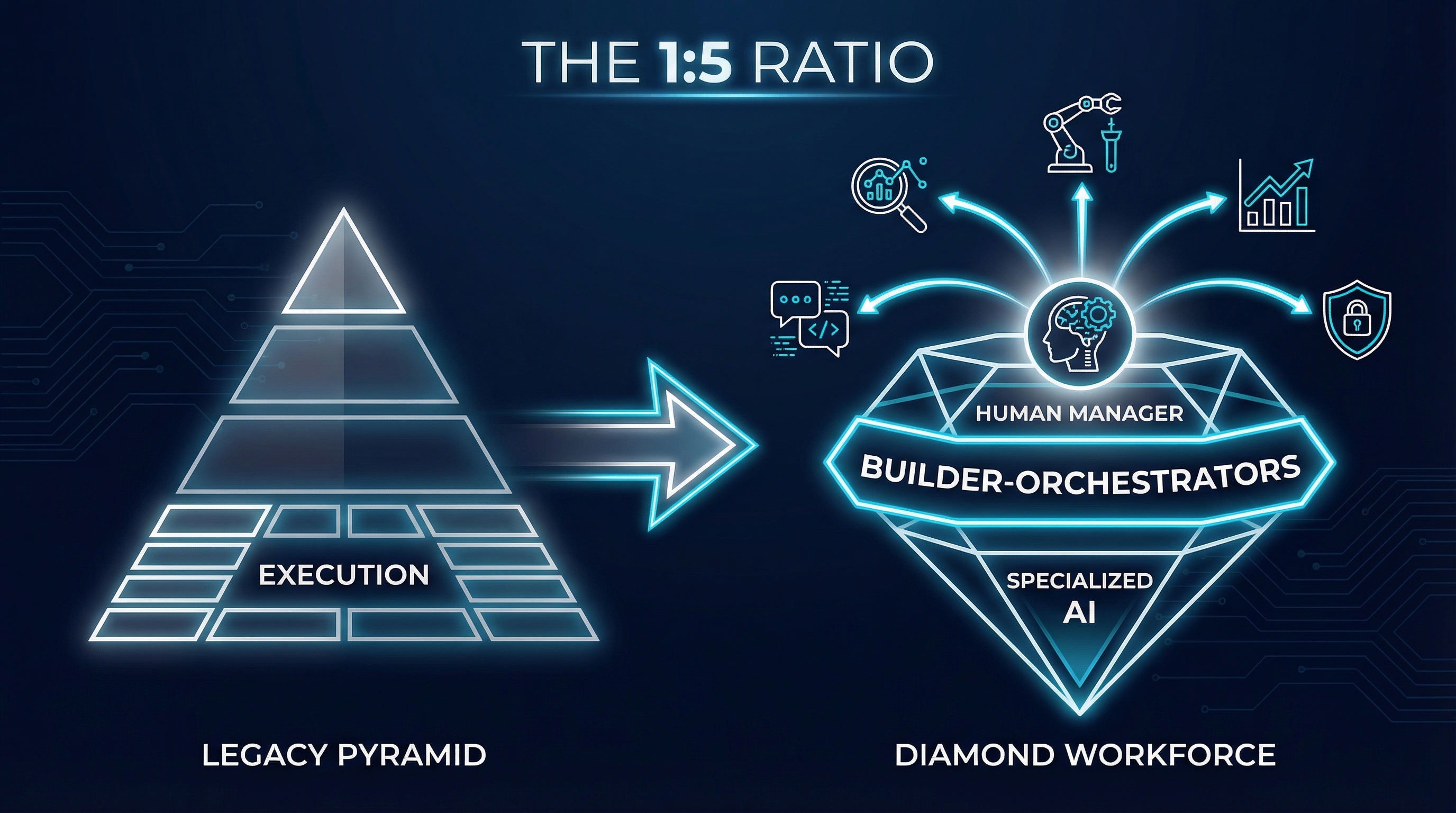
The traditional execution tier is being absorbed by silicon. In its place, we are seeing an expansion of generalist orchestrators who manage their own pods. The competitive moat for a firm in 2026 isn’t having the smartest AI; it’s having the most effective orchestrators.
The era of the ladder is over. The era of the pod has arrived.